Chaimas Frenkelis Villa-Museum
 Venclauskiai House-Museum
 Šiauliai History Museum
 Photography Museum
 Bicycle Museum
 Radio and Television Museum
 Žaliūkiai Village Miller’s Farmstead-Museum
NEWS
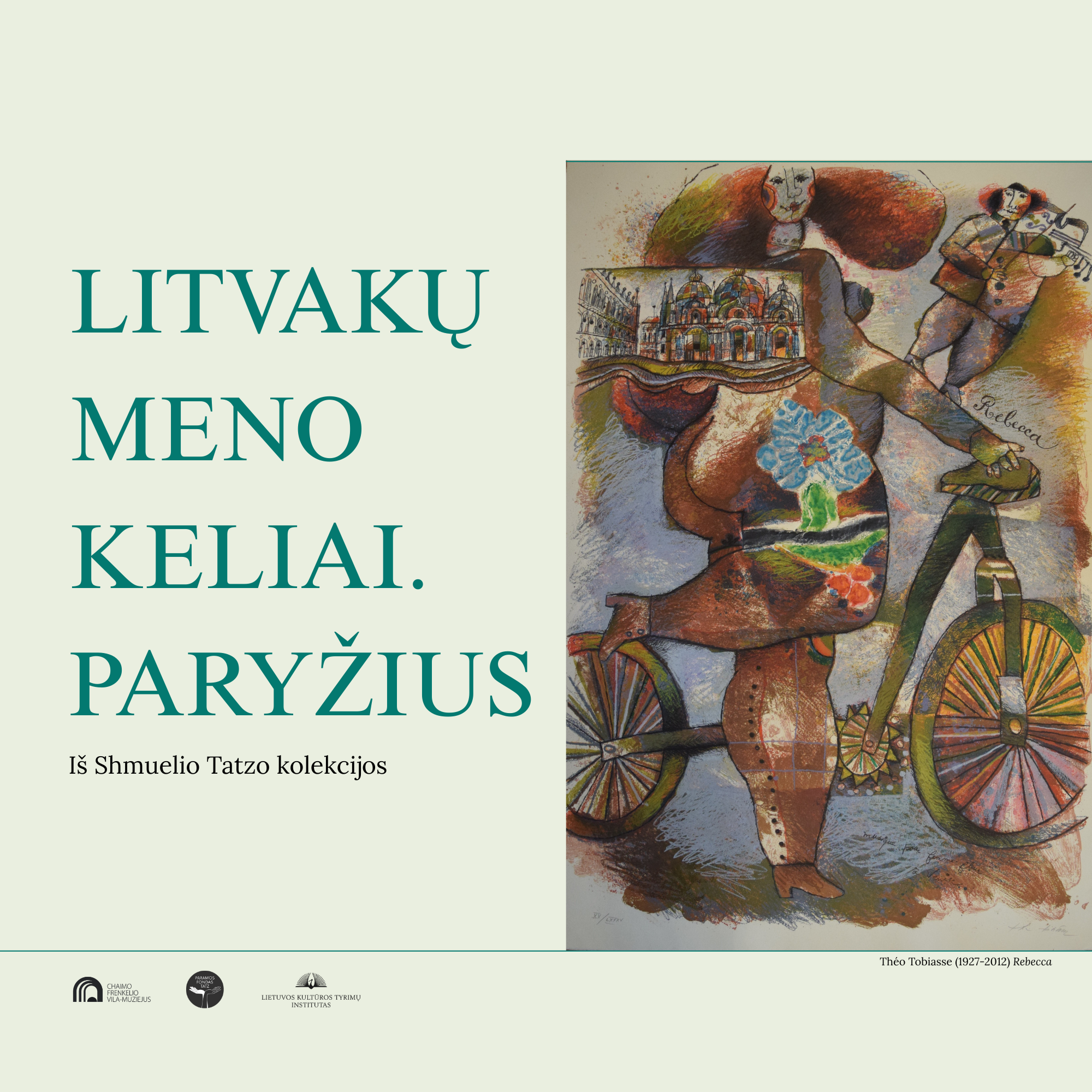
Exhibition "Litvak art paths. Paris"
Exhibition "Litvak art paths. Paris"
2026-07-27
The Chaimas Frenkelis Villa-Museum, one of the most significant sites of Lithuania’s Jewish cultural heritage, provides a meaningful setting for telling the story of Litvak artistic journeys. The villa bears witness to the history of Lithuanian Jewish entrepreneurship, philanthropy, and culture, while today it presents the works of Litvak artists, revealing another dimension of this history—the contribution of Litvaks to twentieth-century world art.
At the beginning of the twentieth century, many artists of Litvak origin found their creative paths converging in Paris, which had become the capital of modern art. There an international community of artists emerged, later known as the École de Paris (School of Paris). Although it had neither a unified programme nor a manifesto, it became a unique “beehive” of twentieth-century modernism—a creative environment where artists of different nationalities, languages, and cultures exchanged ideas and shaped the development of modern art together.
In this exhibition, the term Litvak is used in its historical and cultural sense. It refers to artists originating from the Lithuanian Jewish cultural sphere, which at the turn of the nineteenth and twentieth centuries extended far beyond the borders of present-day Lithuania, encompassing parts of today’s Belarus, Latvia, Poland, and Ukraine. These creators were united not by political boundaries but by a shared religious tradition, Yiddish culture, Litvak intellectual heritage, and cultural memory.
Litvak artists formed an important part of the School of Paris. Although their work matured within the modernist environment of Paris, it continually returned to memories of childhood, stories from the shtetl, biblical narratives, longing for their homeland, and reflections on human identity. Modernist ideas merged with the experience of Eastern European Jewish culture, creating a distinctive artistic language in which memory and the present, tradition and modernity, coexist.
The exhibition is based on the Litvak art collection assembled over many years by collector Shmuel Tatz. This is not merely a collection of artworks gathered by chance, but a coherent narrative about Litvak culture, artistic journeys, and its place in the history of twentieth-century modernism. The exhibition features works by Marc Chagall, Michel Kikoïne, Pinchus Krémègne, Jacques Chapiro, Theo Tobiasse, Arbit Blatas, and many other artists of Litvak origin. Alongside internationally renowned names, the collection also highlights lesser-known artists whose work helps reveal the broader panorama of Litvak art.
The exhibition “Litvak Art Paths. Paris” begins by exploring the geographical reach of Litvak art—artists whose lives and creative journeys extended across different cities and continents, yet who remained connected by a shared cultural memory.
This collection demonstrates that Litvak art is not simply a group of individual masterpieces or the legacy of famous artists. It is a story of cultural memory that unites different generations, cities, and continents. Carefully assembled over many years by Shmuel Tatz, the collection allows this story to unfold as a unified whole—from the Lithuanian Jewish cultural landscape to Paris.
LEARNING TO SEE. Shmuel Tatz’s Journey into Litvak Art
Some people collect paintings. Others collect stories. In Shmuel Tatz’s collection, these two come together. It is a collection that tells not only the story of works of art, but also of the person who sought to discover his own cultural roots through them.
Dr. Samuel Tatz (Shmuel Tatz), a kinesiotherapist living in New York and the creator of the Body Tuning method, has assembled one of the world’s most significant private collections of Litvak art. Born in Alytus, Lithuania, in 1946, he devoted his professional life to working with people, yet over time art became an equally important part of his life.
For many years, Shmuel Tatz’s Manhattan studio earned international recognition. Among his patients were numerous world-renowned artists and performers. Alongside his professional career, however, another passion steadily grew—his interest in art, cultural history, and Litvak heritage.
Tatz associates his cultural roots with Lithuania. From an early age, his appreciation of music, literature, and the visual arts inspired him to explore the history of art. As he himself says:
“Whatever you do, you must do it with feeling, dedication, and a solid education.”
His journey into art began with books, albums, conversations, and meetings with artists. This gradual process of discovery became the foundation of his approach to collecting. One of the first artists in his collection was Samuel Rozin, but the true turning point came when he discovered the history of Litvak art. The writings of Professor Antanas Andrijauskas, which introduced him to the broader context of Litvak culture and art, played a particularly significant role in this journey.
A special place in the collection is devoted to Chaim Soutine, one of the most important Litvak-born masters of twentieth-century modernism. Tatz’s first encounter with Soutine’s work in Jerusalem and Tel Aviv was a deeply emotional experience. It was then that his philosophy of collecting fully took shape: a work of art should not be valued solely for its historical or market significance—it must first and foremost speak to the human spirit.
For this reason, alongside internationally celebrated artists, Shmuel Tatz’s collection also includes lesser-known creators who are equally important to the cultural memory of the Litvak world. They are connected by personal and artistic relationships that help reveal the unity of Litvak artistic heritage. Perhaps this is why Tatz has always believed that the true value of art lies not in prestige or market price, but in people, their stories, and cultural memory. This perspective has led him to give an important place in his collection to lesser-known artists whose work completes the broader narrative of Litvak art.
Today, the Shmuel Tatz Collection includes works by Marc Chagall, Jacques Chapiro, Théo Tobiasse, Michel Kikoïne, Pinchus Krémègne, Ossip Zadkine, Léon Indenbaum, Lázaro Segall, Arbit Blatas, and many other artists of Litvak origin. Yet the collection tells more than the stories of individual artists—it also reveals the wider world of Litvak culture and its contribution to the development of twentieth-century modernism. Of particular significance is the recurring musical theme: musicians, orchestras, festivals, and scenes of communal life become symbols of cultural identity, community, and memory.
Today, the Shmuel Tatz Collection is far more than a collection of artworks. It is an archive of cultural memory that allows visitors to discover the world of Litvak art through individual lives, creative relationships, and history. Through his collection, Shmuel Tatz tells the story of Litvak art not as a simple chronology of facts, but as an ongoing narrative of people, creativity, cultural memory, and enduring connections.
The exhibition is on display until August 16, 2026 in Chaimas Frenkelis villa-museum (Vilniaus dt. 74, Šiauliai, Lithuania).